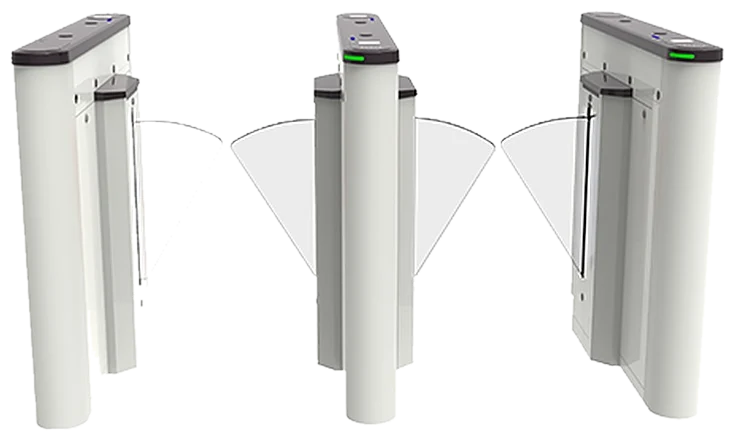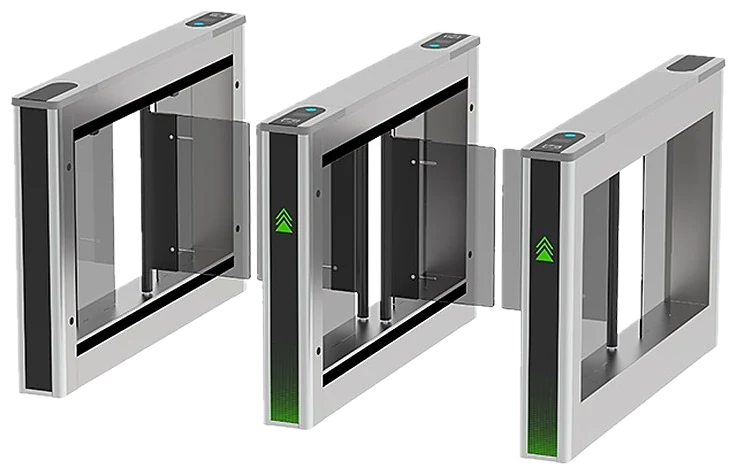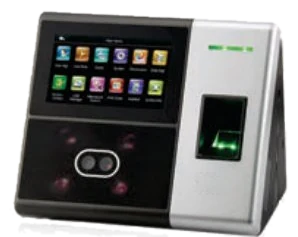
A flap barrier is the slim, waist-high gate you see in office lobbies, IT parks and metro stations. Two retractable flaps open for a valid face, card, QR code or fingerprint and close again behind the person. Flap barriers vary a lot in build, speed and safety. This guide explains what to check so you buy the right one the first time.
1. Is a flap barrier the right gate for your site?
A flap barrier suits indoor or covered entrances with steady or heavy traffic, where you want people to walk through without stopping for long.
It is not the best choice everywhere:
- For an open, unmanned perimeter where someone could jump over, a full height turnstile is more secure.
- For a premium lobby where looks matter most, or where many people carry luggage, a glass swing barrier or speed gate with wider lanes may fit better.
- For a factory gate on a tight budget, a tripod turnstile is usually simpler and cheaper (see our flap vs swing vs tripod comparison).
2. How many lanes do you need?
Work this out from your peak 15 to 20 minutes, not from total headcount. If 300 people arrive between 9:20 and 9:40, that is about 15 people a minute on average, with bursts well above that.
A single flap lane can, in normal use, pass roughly 25 to 30 people a minute. Brochure figures are often higher, so plan with a margin:
- Keep at least one lane for entry and one for exit at busy times; most flap barriers are bi-directional, so the software can switch direction in the morning and evening.
- Add a wide lane for wheelchairs, trolleys, couriers and housekeeping carts.
- Slow face readers, not the barrier, are the usual cause of queues.
3. Lane width and cabinet size
A standard lane is usually around 550 to 600 mm wide. Wide lanes are typically 900 mm or more and are needed for wheelchair access and goods. Before ordering, measure the clear width of your entrance, and leave space for cabinets (each is usually 150 to 300 mm wide) and a gap to walls. Cabinets need a level, solid floor and a cable trench between them.
4. Flap material and height
- Acrylic flaps are the most common.
- Tempered glass flaps look more premium but cost more.
- Taller flaps make it harder to jump or crawl through. They cost more and need a sturdier drive.
For the cabinet, ask for SS304 stainless steel with a brushed finish. Lower grades can rust near wet entrances.
5. Motor, speed and life
Better flap barriers use a brushless DC motor with a proper clutch and controller. They run quietly and last longer under heavy use. Ask the supplier:
- What motor type is used, and is it brushless?
- What is the rated life in cycles?
- Does the flap stop and reverse if it touches a person (anti-pinch)?
- Is there a mechanical clutch so a forced flap does not damage the gearbox?
6. Sensors and anti-tailgating
The infrared sensors inside the cabinets decide how safe and secure the lane is. More sensor pairs mean the barrier can track a person through the lane, detect tailgating, avoid closing on a child or a bag, and raise an alarm for wrong-way entry. Test it yourself: walk close behind a colleague and see whether the barrier raises an alarm.
7. Readers and integration
Choose the reader with care:
- Face recognition is contactless and popular in offices; mount it on a stand or on top of the cabinet at a comfortable height.
- RFID cards are quick and familiar, but cards can be shared.
- QR codes work well for visitors through a visitor management system.
- Fingerprint is common where it doubles as attendance.
Make sure the barrier accepts a standard dry-contact or Wiegand signal so it works with your existing access control software.
8. Fire alarm link and power failure
This is a safety must. The barrier should open all flaps automatically when the fire alarm triggers, so people can leave quickly. Also ask what happens in a power cut: most flap barriers open (fail-safe) so nobody is trapped, and many sites add a small UPS to keep them working through short outages.
9. Price: what drives the cost
Flap barrier prices in India vary widely, so be careful when comparing quotes. As a rough guide only, a basic single-lane flap barrier with a simple reader typically starts at around ₹1.5 lakh, while premium high-speed or glass-flap lanes can cost several lakh per lane. Check whether GST, installation, readers, software and cabling are included, and compare quotes line by line.
Quick checklist before you buy
- Peak-hour headcount and number of lanes, including one wide lane
- Clear entrance width and floor condition
- SS304 cabinet, flap material and flap height
- Brushless motor, anti-pinch and clutch protection
- Sensor pairs and tailgating alarm
- Reader type and access control or attendance integration
- Automatic opening on fire alarm and on power failure
- Warranty, spare parts and AMC support in your city
Mapple Infocom supplies, installs and maintains flap barriers with face, card and QR access in Gurugram and across Delhi NCR. Share your entrance width, peak-hour headcount and a few photos of the lobby, and our team will suggest a suitable layout and plan a site survey.
Our engineers can visit your site and recommend the right option. Call +91 97119 00801 or request a quote.